


From Prototype to Product: How DFM Sets Up a Successful Design Transfer
Bridging the gap between a working prototype and a manufacturable product is one of the most underestimated challenges in medical device development. Design for Manufacturability isn't a final checklist, it's a discipline that must be woven into every stage of your development process, long before design transfer becomes a pressing concern.
Yann hoffbeck
4/1/20262 min read
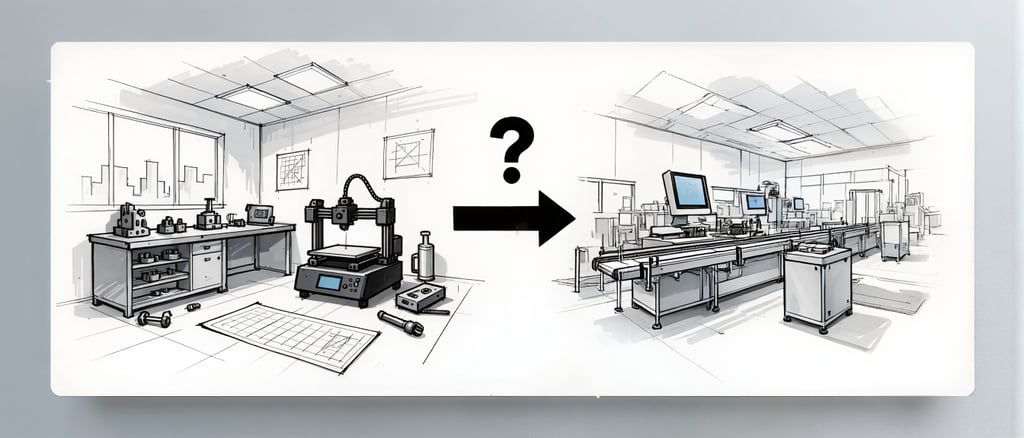
Building a prototype means giving yourself the right to move fast. You start by validating the concept, then you refine: the mechanics, the tolerances, the assembly constraints. You work with available materials rather than final ones, you print what you couldn't yet injection mold, you accept manual assembly steps that no production line will ever replicate. That's the whole point of rapid iteration.
But at some point, the question inevitably arises: can this design actually be manufactured? At scale, with reproducible processes, qualified suppliers, in a regulated environment? If that question is poorly addressed, it can be the source of the most costly blockages at design transfer stage.
DFM: a constraint to integrate as early as possible
Design for Manufacturability should be built into the development process as early as possible, ideally as soon as the concept is stable, well before the final design iterations. At each project milestone, it answers two fundamental questions:
Can this design be manufactured using the target industrial processes?
What variability will those processes introduce and does the design accommodate it?
The second point deserves attention. A prototype printed in SLA may hold dimensional tolerances that an injection molding process won't necessarily replicate, due to material shrinkage, parting lines, and draft constraints. But beyond dimensional tolerances, mechanical properties must also be considered: will the part made from the final material have the same flexibility, the same fatigue resistance, the same behavior under load? A substitute material used in prototyping can mask weaknesses that will only surface in series production.
Integrating DFM into the development process
Under ISO 13485, the development process is structured around documented milestones: design inputs, design outputs, verification, validation, design transfer. DFM is a transversal constraint that influences each of them. In practice, this comes down to three key principles.
Build manufacturing constraints into the design inputs. Target processes, anticipated supplier base, sterilization constraints, expected production volumes: these parameters must be documented from the requirements definition phase. Design inputs that ignore them will mechanically generate problems downstream.
Involve manufacturing teams from the earliest iterations. The classic mistake is treating DFM as a sequential validation. Engineers design first, then industrial teams review. This logic produces costly back-and-forth. Integrating process constraints into the design loop from the start is what prevents late-stage redesigns.
Document design decisions as you go. The Design History File, as its name suggests, documents the history of the design, day by day, not at the end of the project. Every technical decision, every compromise accepted during prototyping, must be recorded and justified. This is both an ISO 13485 requirement and a practical condition for a solid design transfer.
Design transfer: where DFM delivers
Design transfer is the point at which all design outputs are formally handed over, not just to manufacturing, but to the full operational chain: production, supply chain, quality control, and where applicable, servicing. ISO 13485 §7.3.8 is explicit: outputs must be verified as suitable for manufacturing before becoming final production specifications.
Concretely, this milestone covers process validation (IQ/OQ/PQ), supplier qualification, staff training on manufacturing procedures, and the completion of a Device Master Record. Its rigor directly conditions the ability to produce in a compliant, reproducible way and to withstand an audit.
When these elements haven't been built up continuously throughout development, the consequences are predictable: a divergence between what the designer intended and what the factory floor can actually deliver, translating into low manufacturing yields, rework, unplanned redesign, or unexpectedly high servicing costs. These are the natural outcomes of DFM treated as a secondary concern rather than a structural project constraint.
© 2026. All rights reserved.


Site map
Contract medical device development in cardiovascular and minimally invasive surgery.